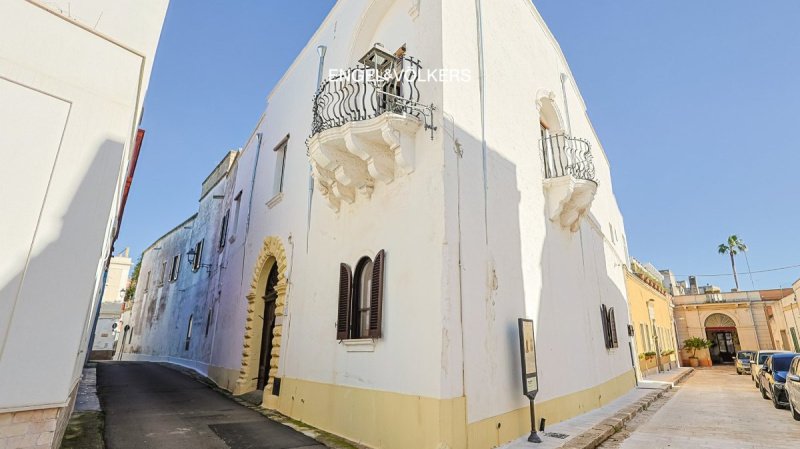
Palazzo Ceuli in the historic center of Salve is an ancient property built at the end of the 1500s, with great tourist and residential potential.
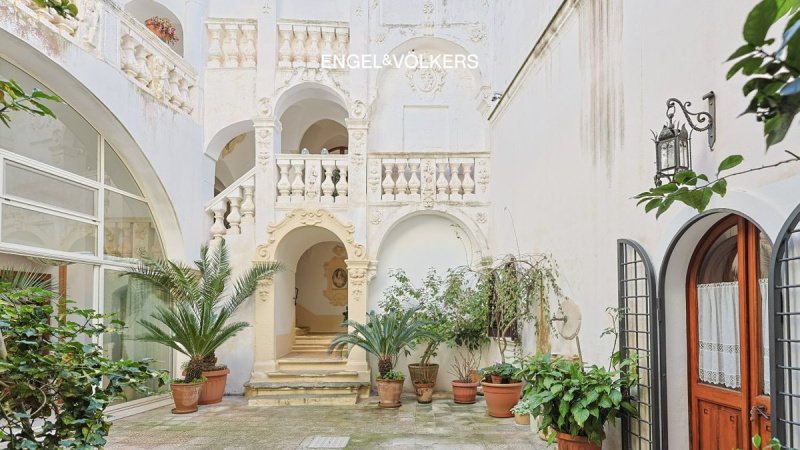
It reflects the typical layout, with internal areas developing in a circular manner around a central courtyard.
The scenic effect is very striking, thanks to staircases, 17th-century balconies and hand-worked local stone balustrades. Coats of arms, decorations, and religious and pagan motifs embellish every façade.
The ground floor currently includes a three-room apartment and a studio apartment, each with a bathroom and a kitchen.
The first floor consists of an ancient area of three rooms with star vaults and two small balconies; in the main hall there is a historic mosaic floor that sparkles with the sunlight reflected as it passes through the doors of the large balconies. The more recent part consists of rooms with flat ceilings, with two livable terraces offering panoramic views over the center and toward the sea.
The rooftop terrace is walkable and includes an additional historic room, currently used as an attic, and two utility rooms.
Equipped with a heating system with cast-iron radiators, it was partially renovated in 2011 and retains a working fireplace in the kitchen.
The energy rating is consistent with the age of the window and door frames: wood in the historic part, aluminum in the more recent part. However, the walls about one meter thick and the large roof surfaces make it well suited to easily achieve a very high energy class. The inner courtyard has potential as a semi-indoor covered area.
It is a unique residence, well exposed and overlooking the town’s ancient streets and the main square.
From the terrace you can see the façade of the mother church of Salve, dedicated to Saint Nicholas the Great, the patron protector. It is inhabited and provided with all connections to essential services.
自动翻译所用的语言
Palazzo Ceuli nel centro storico di Salve è un'antica proprietà costruita alla fine del 1500, con grandi potenzialità turistiche e residenziali.
Rispecchia l'impianto tipico, con zone interne che si sviluppano in senso circolare, intorno ad una corte centrale.
L'effetto scenico è molto marcato, grazie a scale, balconi seicenteschi e balaustre in pietra locale, lavorate a mano. Stemmi, decori, richiami religiosi e pagani, impreziosiscono ogni facciata.
Il piano terra oggi accoglie un trilocale e un monolocale, ciascuno con un bagno e una cucina.
Il primo piano è composto da una zona antica di tre stanze con volte a stella e due piccoli balconi; nel salone è presente uno storico pavimento realizzato a mosaico che luccica con il riflesso del sole che attraversa le porte dei grandi balconi. La parte più recente è composta da stanze con volta piana, con due terrazze abitabili con vista panoramica sul centro e verso il mare.
L'area solare è calpestabile e dotata di un ulteriore vano storico, attualmente utilizzato come soffitta e due locali tecnici.
Dotata di impianto di riscaldamento con elementi in ghisa, è stata parzialmente ristrutturata nel 2011 e conserva un camino attivo in cucina.
La classe energetica è compatibile con la vetustà degli infissi, in legno nella parte storica, alluminio nella parte più recente. Tuttavia i muri spessi circa un metro e le ampie superfici dei tetti, la predispongono facilmente a raggiungere una classe energetica molto alta. La corte interna ha un potenziale come zona semi-interna coperta.
E' una residenza unica, ben esposta e con affaccio sulle strade antiche del paese e sulla piazza. Dal terrazzo si vede la facciata della chiesa madre di Salve, intitolata a San Nicola Magno, protettore. E' abitata e dotata di tutti gli allacci ai servizi essenziali.
Der Palazzo Ceuli im historischen Zentrum von Salve ist ein antikes Anwesen, das Ende des 16. Jahrhunderts erbaut wurde und über großes touristisches und wohnwirtschaftliches Potenzial verfügt.
Er spiegelt die typische Bauweise wider, mit Innenbereichen, die sich kreisförmig um einen zentralen Innenhof entwickeln.
Die szenische Wirkung ist sehr eindrucksvoll, dank Treppen, Balkonen aus dem 17. Jahrhundert und handgearbeiteten Balustraden aus lokalem Stein. Wappen, Verzierungen sowie religiöse und heidnische Motive schmücken jede Fassade.
Im Erdgeschoss befinden sich derzeit eine Dreizimmerwohnung und ein Studio-Apartment, jeweils mit Bad und Küche.
Das erste Obergeschoss besteht aus einem historischen Bereich mit drei Räumen mit Sterngewölben und zwei kleinen Balkonen; im Salon befindet sich ein historischer Mosaikboden, der im Sonnenlicht funkelt, wenn dieses durch die Türen der großen Balkone einfällt. Der neuere Teil besteht aus Räumen mit Flachdecken sowie zwei bewohnbaren Terrassen mit Panoramablick über das Ortszentrum und bis zum Meer.
Die Dachterrasse ist begehbar und verfügt über einen weiteren historischen Raum, der derzeit als Dachboden genutzt wird, sowie über zwei Technikräume.
Das Gebäude ist mit einer Heizungsanlage mit gusseisernen Heizkörpern ausgestattet, wurde 2011 teilweise renoviert und verfügt über einen funktionstüchtigen Kamin in der Küche.
Die Energieeffizienzklasse entspricht dem Alter der Fenster – Holzfenster im historischen Teil, Aluminiumfenster im neueren Bereich.
Dennoch ermöglichen die etwa einen Meter dicken Mauern und die großen Dachflächen problemlos eine spätere Aufwertung auf eine sehr hohe Energieklasse.
Der Innenhof bietet Potenzial als halbüberdachter, geschützter Bereich. Es handelt sich um eine einzigartige Residenz mit sehr guter Ausrichtung und Blick auf die alten Straßen des Ortes sowie auf den Hauptplatz.
Von der Terrasse aus sieht man die Fassade der Mutterkirche von Salve, die dem Schutzpatron San Nicola Magno geweiht ist. Das Gebäude ist bewohnt und an alle grundlegenden Versorgungsleitungen angeschlossen.
Palais Ceuli, dans le centre historique de Salve, est une ancienne propriété construite à la fin des années 1500, offrant un grand potentiel touristique et résidentiel.
Elle reflète l’agencement typique, avec des espaces intérieurs se développant de manière circulaire autour d’une cour centrale. L’effet scénique est très marqué, grâce à des escaliers, des balcons du XVIIe siècle et des balustrades en pierre locale, taillées à la main. Armoiries, décors, références religieuses et païennes embellissent chaque façade.
Le rez-de-chaussée accueille aujourd’hui un appartement de trois pièces et un studio, chacun avec une salle de bains et une cuisine.
Le premier étage se compose d’une partie ancienne de trois pièces avec voûtes en étoile et deux petits balcons ; dans le salon se trouve un sol historique en mosaïque qui scintille sous les reflets du soleil traversant les portes des grands balcons. La partie plus récente comprend des pièces à plafond plat, avec deux terrasses habitables offrant une vue panoramique sur le centre et vers la mer.
La toiture-terrasse est praticable et dispose d’une pièce historique supplémentaire, actuellement utilisée comme grenier, ainsi que de deux locaux techniques. Équipée d’un chauffage avec radiateurs en fonte, elle a été partiellement rénovée en 2011 et conserve une cheminée en fonctionnement dans la cuisine. La classe énergétique est compatible avec l’ancienneté des menuiseries : bois dans la partie historique, aluminium dans la partie plus récente. Toutefois, les murs d’environ un mètre d’épaisseur et les grandes surfaces de toiture la prédisposent aisément à atteindre une classe énergétique très élevée.
La cour intérieure présente un potentiel en tant qu’espace semi-intérieur couvert.
C’est une résidence unique, bien exposée, donnant sur les anciennes rues du village et sur la place. Depuis la terrasse, on voit la façade de l’église mère de Salve, dédiée à Saint Nicolas le Grand, protecteur. Elle est habitée et dotée de tous les raccordements aux services essentiels.