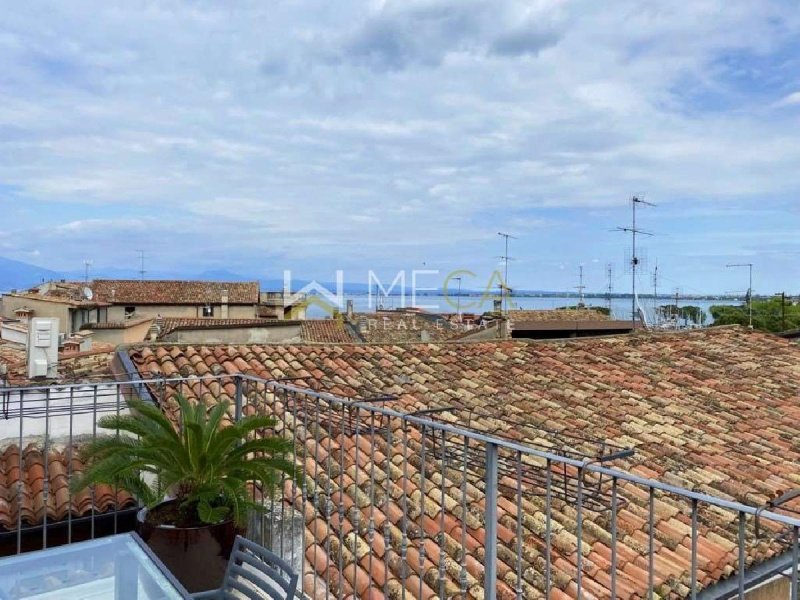
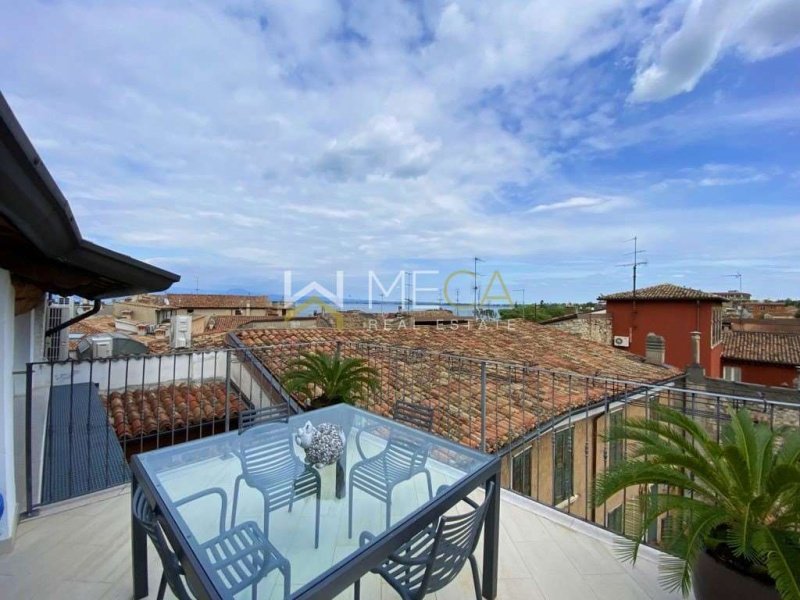
Desenzano del Garda, lakefront, renovated penthouse on two floors, served by an elevator that leads directly to the apartment.
The penthouse boasts an excellent lake view from the terrace and is very luxurious and welcoming:
It comprises a living room with bathroom, eat-in kitchen, and dining room, all of which open onto a 20 sq m terrace with lake views;
the sleeping area includes two double bedrooms with en suite bathrooms and access to a small internal terrace, another bathroom, plus a storage room and laundry room.
It is possible to easily create a third bedroom.
Exceptional location just steps from the lakefront, recently renovated.
Lake Garda
Lake Garda or Benaco is the largest Italian lake, with a surface area of about 370 km² (third in depth after Como and Maggiore). A hinge between three regions, Lombardy (province of Brescia), Veneto (province of Verona), Trentino-Alto Adige (province of Trento), it is placed parallel to the Adige, from which it is divided by the massif of Mount Baldo. To the north it is narrow in a funnel while to the south it widens, surrounded by morainic hills which make the landscape gentler.The lake is an important tourist destination and is visited by millions of people every year. In Roman times the lake was known as Benacus and by some it was revered as the god Benacus, personification of the lake itself, sometimes associated with the cult of the god Neptune. Today it is better known as Lake Garda, a toponym attested since the Middle Ages and of Germanic origin, deriving from that of the town of the same name on the Veronese side of the lake, which, together with another famous locality on the lake, Gardone Riviera, and other less known, such as Gàrdola, Gardoncino, Gardoni, Guàrdola and Le Garde, testify to the Germanic presence that goes from the 6th to the 8th century, in particular the Lombard one. The toponym Garda, with which the lake is already called in some documents of the eighth century, is the evolution of the Germanic word warda, or "place of guard" or "place of observation". The classic toponym of the lake, or Bencus lacus (Benaco), is almost certainly of Celtic origin, therefore prior to Roman rule, and should derive from bennacus, comparable with the Irish bennach, and would mean "horned", or with many promontories.The translation "cuckold" is also interpreted in reference to the peninsula of Sirmione. The Latin voice of Benaco is attested as Bencus, -i and therefore assumes a flat accent (Benàco): the Italian version of the tonic accent remains faithful to the Latin accent, therefore it must be pronounced with the accent on the "a".
自动翻译所用的语言
Desenzano del Garda, lungolago, attico ristrutturato e strutturato su due piani e servito da ascensore, il quale porta direttamente nell'appartamento.
L'attico ha una vista lago ottima dalla terrazza ed è molto lussuoso e accogliente:
composto da sala con bagno, cucina abitabile e sala da pranzo le quali godono di accesso sulla terrazza abitabile di 20 mq con vista lago;
zona notte con due camere matrimoniali con bagno en suite e accesso a terrazzina interna, ulteriore bagno, più ripostiglio e lavanderia.
Possibilità di realizzare comodamente la terza camera.
Posizione eccezionale a due passi dal lungolago, ristrutturazione recente.
Il lago di Garda
Il lago di Garda o Benaco è il maggiore lago italiano, con una superficie di circa 370 km² (terzo per profondità dopo Como e Maggiore). Cerniera fra tre regioni, Lombardia (provincia di Brescia), Veneto (provincia di Verona), Trentino-Alto Adige (provincia di Trento), è posto in parallelo all'Adige, da cui è diviso dal massiccio del monte Baldo. A settentrione si presenta stretto a imbuto mentre a meridione si allarga, circondato da colline moreniche che rendono più dolce il paesaggio. Il lago è un'importante meta turistica ed è visitato ogni anno da milioni di persone. In epoca romana il lago era conosciuto come Benacus e da alcuni era venerato come dio Benacus, personificazione stessa del lago, talvolta associata al culto del dio Nettuno. Oggi è meglio noto come lago di Garda, toponimo attestato fin dal Medioevo e di origine germanica, derivante da quello dell'omonima cittadina sulla sponda veronese del lago, la quale, insieme a un'altra località celebre del lago, Gardone Riviera, e altre meno conosciute, come Gàrdola, Gardoncino, Gardoni, Guàrdola e Le Garde, testimonia la presenza germanica che va dal VI all'VIII secolo, in particolare quella longobarda. Il toponimo Garda, con il quale è chiamato il lago già in alcuni documenti dell'VIII secolo, è l'evoluzione della voce germanica warda, ovvero luogo di guardia o luogo di osservazione. Il toponimo classico del lago, ovvero Bencus lacus (Benaco), è quasi sicuramente di origine celtica, precedente quindi al dominio romano, e dovrebbe derivare da bennacus, confrontabile con l'irlandese bennach, e significherebbe cornuto, ovvero dai molti promontori. La traduzione cornuto viene anche interpretata in riferimento alla penisola di Sirmione. La voce latina di Benaco è attestata come Bencus, -i e presuppone quindi un accento piano (Benàco): la versione italiana dell'accento tonico rimane fedele all'accentazione latina, quindi va pronunciato con l'accento sulla a.
CLASSE ENERGETICA: D 143,98 kWh/m3 a
Desenzano del Garda, direkt am Seeufer: Renoviertes Penthouse auf zwei Etagen mit direktem Aufzugzugang.
Das Penthouse besticht durch einen herrlichen Seeblick von der Terrasse und ist luxuriös und einladend:
Es umfasst ein Wohnzimmer mit Bad, eine Wohnküche und ein Esszimmer, die alle auf eine 20 qm große Terrasse mit Seeblick führen;
der Schlafbereich besteht aus zwei Doppelzimmern mit jeweils eigenem Bad und Zugang zu einer kleinen Innenterrasse, einem weiteren Badezimmer sowie einem Abstellraum und einer Waschküche.
Ein drittes Schlafzimmer kann problemlos eingerichtet werden. Außergewöhnliche Lage, nur wenige Schritte vom Seeufer entfernt, kürzlich renoviert.
Gardasee
Der Gardasee oder Benaco ist der größte italienische See mit einer Fläche von etwa 370 km² (drittgrößter See nach Como und Maggiore). Als Scharnier zwischen den drei Regionen Lombardei (Provinz Brescia), Venetien (Provinz Verona) und Trentino-Südtirol (Provinz Trient) liegt es parallel zur Etsch, von der es durch das Massiv des Monte Baldo getrennt wird. Im Norden ist es trichterförmig schmal, während es im Süden breiter wird und von Moränenhügeln umgeben ist, die die Landschaft sanfter machen. Der See ist ein wichtiges Touristenziel und wird jedes Jahr von Millionen Menschen besucht. In der Römerzeit war der See als Benacus bekannt und von einigen wurde er als Gott Benacus verehrt, der die Personifikation des Sees selbst war, was manchmal mit dem Kult des Gottes Neptun in Verbindung gebracht wurde. Heute ist es besser bekannt als Gardasee, ein seit dem Mittelalter bezeugter Ortsname germanischen Ursprungs, der sich von dem gleichnamigen Ort auf der veronesischen Seite des Sees ableitet, der zusammen mit einem anderen berühmten Ort am See Gardone Riviera und andere weniger bekannte Orte wie Gàrdola, Gardoncino, Gardoni, Guàrdola und Le Garde zeugen von der germanischen Präsenz vom 6. bis zum 8. Jahrhundert, insbesondere der lombardischen. Der Ortsname Garda, mit dem der See bereits in einigen Dokumenten des 8. Jahrhunderts bezeichnet wird, ist eine Weiterentwicklung des germanischen Wortes warda, was Ort der Wache oder Ort der Beobachtung bedeutet. Der klassische Ortsname des Sees, oder Bencus lacus (Benaco), ist mit ziemlicher Sicherheit keltischen Ursprungs, also vor der römischen Herrschaft, und sollte von bennacus abgeleitet sein, vergleichbar mit dem irischen bennach, und würde gehörnt oder mit vielen Vorgebirgen bedeuten . Die Übersetzung Hahnrei wird auch in Bezug auf die Halbinsel Sirmione interpretiert. Die lateinische Stimme von Benaco ist als Bencus, -i bezeugt und nimmt daher einen flachen Akzent (Benàco) an: Die italienische Version des tonischen Akzents bleibt dem lateinischen Akzent treu, daher muss er mit dem Akzent auf dem a ausgesprochen werden.