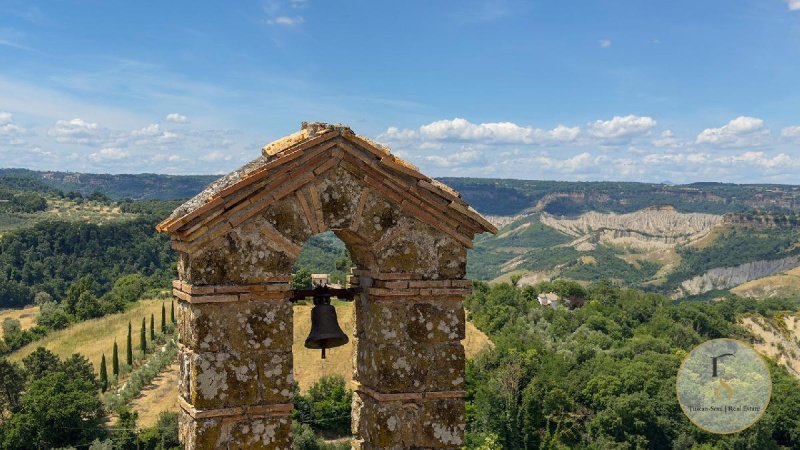
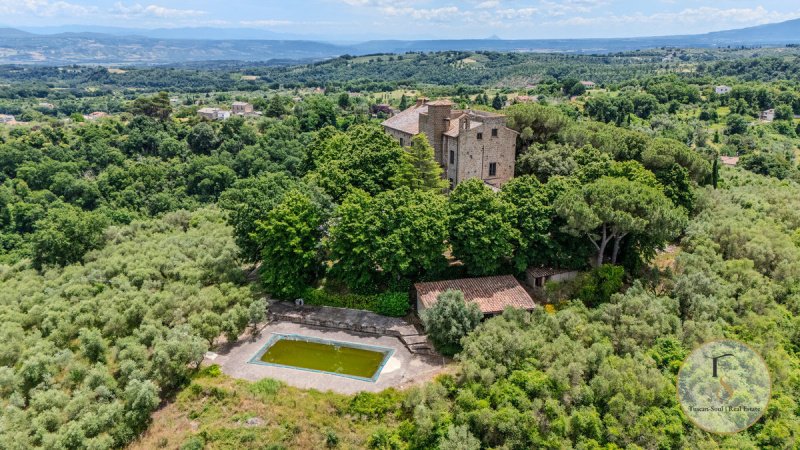
A 17th-century castle with a 14th-century hermitage and chapel; approved plans for a 25-room boutique hotel, 3,000 olive trees and views over Civita di Bagnoregio, in the Tuscia region of Lazio Ref. VIT333 In the heart of Tuscia, some 90 km north of Rome, a promontory overlooks one of Italy’s most unique landscapes: the Valle dei Calanchi, with its wind-sculpted clay ridges and, perched on its tuff cliff, the solitary silhouette of Civita di Bagnoregio. Here, where the sunset’s light bathes the valley walls in pink, stands a historic complex where seven centuries have layered upon one another without erasing each other, set within a landscape that has remained almost untouched. The avenue and the park You arrive by walking along a long avenue of cypress trees, which draws the eye and slows your pace before the complex comes into view, nestled within a park of pine and holm oak trees. In the shade of those trees, the silence is broken only by the wind rising from the valley, and one has the sensation of entering a place that has always lived according to its own rhythm. Three eras, one place The historic centre consists of three buildings that interact with one another. The 17th-century castle forms the main body of the complex, with the imposing scale and presence characteristic of the ancient fortified residences of Tuscia. Next to it, the 14th-century hermitage harbours a more ancient and intimate history – that of those who chose this ridge for its tranquillity – and is an extremely rare feature within a private estate. The ensemble is completed by the 14th-century chapel, contemporary with the hermitage, which imbues the place with a spiritual depth perceptible in every stone. The buildings within the historic complex underwent structural stabilisation in 1986 and, together with the basement and a 56-square-metre terrace overlooking the landscape, cover a total area of 1,384 square metres. In 2000, two further buildings were added: a 110-square-metre villa and a 188-square-metre building intended as a restaurant, bringing the total floor area to 1,682 square metres. The land The 19 hectares of land form a varied landscape around the buildings: olive groves with around 3,000 trees, which in autumn evoke the ancient rhythm of the harvest, and wooded areas sloping down towards the valley. A private spring ensures the estate’s water self-sufficiency, a tangible asset in a countryside where water has always shaped local life. A project already in the pipeline The property has an approved plan for the construction of a retreat and boutique hotel with around 25 rooms, designed for boutique hospitality, events and weddings. Preparatory work for the renovation has already been carried out, meaning that anyone choosing to proceed will be starting from a point where the planning permission process has been finalised and construction work has already begun. Upon request, it is possible to take over a long-term lease agreement with a German hotel operator, with rental income commencing immediately upon purchase. A technical, town planning and land registry due diligence report is available for interested parties. Tuscia and Rome The main amenities are located approximately 2.5 km away. Civita di Bagnoregio, Lake Bolsena, Orvieto and the Etruscan villages of Tuscia are a short distance away, whilst Rome can be reached in about an hour and a half by road. Rome Ciampino Airport is approximately 100 km away, and Rome Fiumicino Airport is approximately 120 km away.
自动翻译所用的语言
Castello del XVII secolo con eremo e cappella del XIV secolo, progetto approvato per boutique hotel da 25 camere, 3.000 ulivi e vista su Civita di Bagnoregio, Tuscia laziale Rif. VIT333 Nella Tuscia più autentica, a circa 90 km a nord di Roma, un promontorio si affaccia su uno dei paesaggi più singolari d'Italia: la Valle dei Calanchi, con le sue creste d'argilla scolpite dal vento e, sospesa sulla sua rupe di tufo, la sagoma solitaria di Civita di Bagnoregio. Qui, dove la luce del tramonto accende di rosa le pareti della valle, sorge un complesso storico nel quale sette secoli si sono posati uno sull'altro senza cancellarsi, in un paesaggio rimasto quasi intatto. Il viale e il parco Si arriva percorrendo un lungo viale di cipressi, che accompagna lo sguardo e rallenta il passo prima che il complesso si riveli, raccolto in un parco di pini e lecci. All'ombra di quelle chiome il silenzio è interrotto soltanto dal vento che sale dalla valle, e si ha la sensazione di entrare in un luogo che ha sempre vissuto secondo un tempo suo. Tre epoche, un solo luogo Il nucleo storico si compone di tre architetture che dialogano tra loro. Il castello del XVII secolo è il corpo principale del complesso, con la mole e la presenza delle antiche dimore fortificate della Tuscia. Accanto, l'eremo del XIV secolocustodisce una storia più antica e raccolta, quella di chi scelse questo crinale per la sua quiete, ed è una presenza rarissima all'interno di una proprietà privata. Completa l'insieme la cappella trecentesca, coeva all'eremo, che conferisce al luogo una profondità spirituale percepibile in ogni pietra. Le strutture del complesso storico sono state oggetto di un consolidamento statico nel 1986 e insieme, con il seminterrato e una terrazza di 56 mq affacciata sul paesaggio, raggiungono 1.384 mq. Nel 2000 si sono aggiunti due fabbricati: una villa di 110 mq e un edificio di 188 mq destinato a ristorante, per una superficie complessiva di 1.682 mq. La terra I 19 ettari di terreno disegnano attorno agli edifici un paesaggio vario: uliveti con circa 3.000 piante, che d'autunno restituiscono il ritmo antico della raccolta, e aree boschive che scendono verso la valle. Una sorgente propria garantisce l'autonomia idrica della tenuta, un pregio concreto in una campagna dove l'acqua ha sempre segnato la vita dei luoghi. Un progetto già tracciato La proprietà dispone di un progetto approvato per la realizzazione di un retreat e boutique hotel di circa 25 camere, pensato per l'ospitalità di charme, gli eventi e i matrimoni. Le opere preparatorie alla ristrutturazione sono già state eseguite, così che chi sceglie di proseguire parte da un percorso autorizzativo concluso e da un cantiere già avviato. Su richiesta è possibile subentrare in un contratto di locazione a lungo termine con un operatore alberghiero tedesco, con una rendita attiva fin dall'acquisto. Per gli interessati è disponibile una due diligence tecnica, urbanistica e catastale. La Tuscia e Roma I servizi principali si trovano a circa 2,5 km. Civita di Bagnoregio, il lago di Bolsena, Orvieto e i borghi etruschi della Tuscia sono a breve distanza, mentre Roma si raggiunge in circa un'ora e mezza di strada. L'aeroporto di Roma Ciampino dista circa 100 km, quello di Roma Fiumicino circa 120 km.