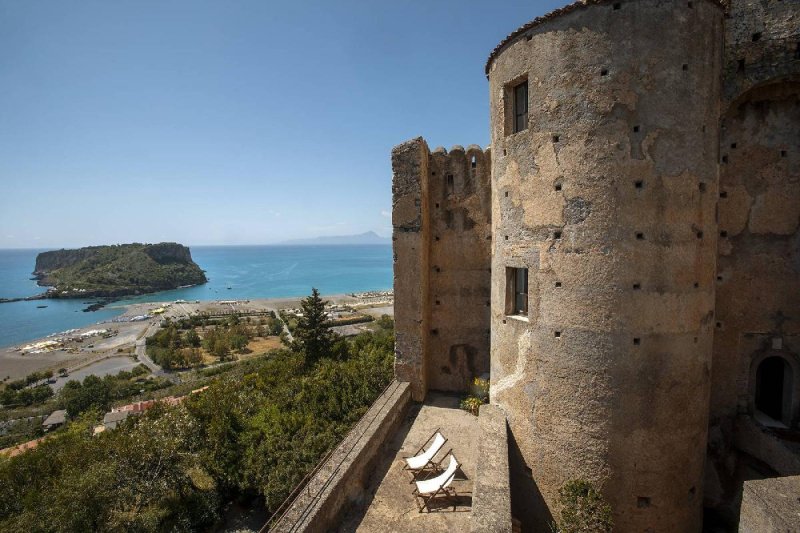
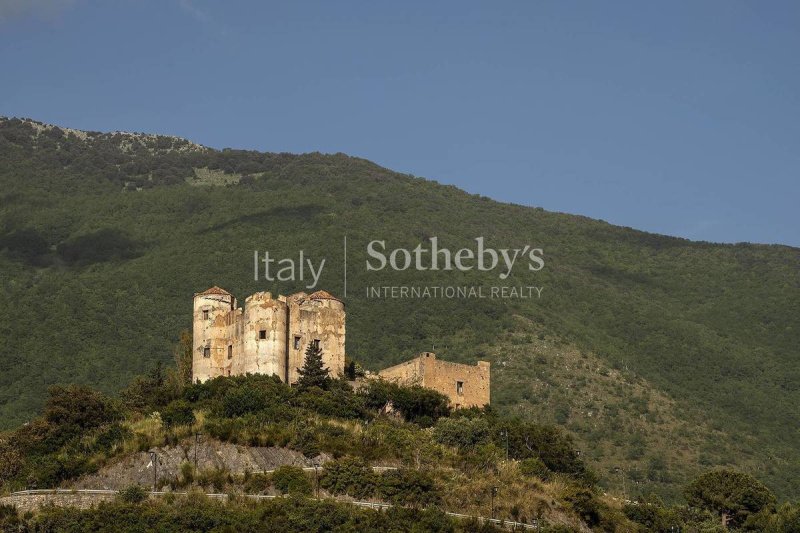
The Castello di Fiuzzi, also known as the Praia a Mare Castle, was built between the 12th and 13th centuries as a military structure, thanks to its strategic position. It stands on a small hill facing the "Isola di Dino," overlooking a vast stretch of sea and coastline.
The fortress was commissioned by the King of Naples to defend the coast from Saracen and Aragonese incursions. At the end of the 16th century, Bishop Matteo Cosentini d'Aieta, the local feudal lord, used it as a summer residence. In the 18th century, the fiefdom was sold to other noble families. In the early 1950s, a direct descendant of the Cosentini d'Aieta family repurchased the castle and decided to restore it to its former glory through an elegant conservative restoration. The original coat of arms of the Cosentini d'Aieta marquises can still be seen on the entrance portal.
The structure has a rectangular layout with two cylindrical towers connected by wide walls, partially original, adorned with Arab-style battlements. Inside, the architecture features white cement floors, whitewashed walls, and vaulted ceilings, with minimal furniture and decorative elements. During the 1950s renovation, six bedrooms, each with its own private bathroom, were created from the original structure. Outside, in the garden, there is a small chapel that still hosts ceremonies and religious functions today.
The building is surrounded by over one hectare of typical Mediterranean vegetation and tall cypress trees.
自动翻译所用的语言
Il Castello di Fiuzzi, conosciuto anche come Castello di Praia a Mare, nasce tra il XII e il XIII secolo come costruzione militare, grazie alla sua posizione strategica, essendo edificato su di una piccola altura di fronte all' "Isola di Dino" e dominando un ampio tratto di mare e di costa.
La roccaforte infatti fu ideata, per volere del Re di Napoli, per difendere la costa dalle incursioni saracene e aragonesi. Alla fine del XVI secolo il vescovo feudatario del luogo, Matteo Cosentini d'Aieta, vi abitò utilizzandolo come residenza estiva. Nel XVIII secolo, il feudo fu ceduto ad altre nobili famiglie: nei primi anni '50 del Novecento, il discendente primogenito dei Cosentini d'Ajeta, riacquistò il castello decidendo di riportarlo allo splendore di un tempo, con un elegante restauro conservativo. È ancora possibile vedere lo stemma gentilizio originale dei marchesi Cosentini d'Aieta sul portale d'ingresso.
La struttura ha pianta rettangolare con due torri cilindriche collegate da ampie mura e rifinite da merlature, in parte originali, di gusto arabo. All'interno, l'architettura è caratterizzata da pavimenti in cemento bianco, pareti e volte a calce bianca con pochi mobili ed elementi di arredo: durante la ristrutturazione degli anni '50 sono state ricavate, dalla struttura originale, le sei attuali camere da letto, ciascuna dotata del proprio bagno privato. All'esterno, nel giardino, si trova una piccola cappella che ancora oggi ospita cerimonie e funzioni religiose.
L'edificio è circondato da un terreno di oltre un ettaro di tipica macchia mediterranea e alti cipressi.
Die Burg von Fiuzzi, auch bekannt als die Burg von Praia a Mare, entstand zwischen dem 12. und 13. Jahrhundert als militärische Festung, dank ihrer strategischen Lage. Sie wurde auf einer kleinen Anhöhe gegenüber der "Isola di Dino" erbaut und beherrscht einen weiten Küstenabschnitt sowie das Meer.
Die Festung wurde auf Befehl des Königs von Neapel errichtet, um die Küste vor sarazenischen und aragonesischen Überfällen zu schützen. Ende des 16. Jahrhunderts diente sie dem örtlichen Bischof und Lehnsherrn Matteo Cosentini d'Aieta als Sommerresidenz. Im 18. Jahrhundert wurde das Lehen an andere Adelsfamilien weitergegeben. In den frühen 1950er Jahren erwarb der erstgeborene Nachkomme der Familie Cosentini d'Ajeta die Burg zurück und entschied sich für eine elegante Restaurierung, um ihren einstigen Glanz wiederherzustellen. Das originale Wappen der Markgrafen Cosentini d'Aieta ist noch heute am Eingangstor zu sehen.
Die rechteckige Anlage verfügt über zwei zylindrische Türme, die durch breite Mauern mit teilweise originalen, im arabischen Stil gestalteten Zinnen verbunden sind. Im Inneren besticht die Architektur durch weiße Zementböden, weiß gekalkte Wände und Gewölbe sowie eine minimalistische Möblierung. Während der Renovierung in den 1950er Jahren wurden aus der ursprünglichen Struktur sechs Schlafzimmer geschaffen, von denen jedes über ein eigenes Badezimmer verfügt. Im Außenbereich befindet sich im Garten eine kleine Kapelle, in der noch heute Zeremonien und religiöse Feiern abgehalten werden.
Das Gebäude ist von einem mehr als einen Hektar großen Grundstück mit typischer mediterraner Macchia und hohen Zypressen umgeben.
Le Castello di Fiuzzi, également connu sous le nom de Château de Praia a Mare, a été construit entre les XIIe et XIIIe siècles en tant que structure militaire, grâce à sa position stratégique. Il se dresse sur une petite colline face à l'« Isola di Dino », surplombant une vaste étendue de mer et de littoral.
La forteresse a été commandée par le roi de Naples pour défendre la côte contre les incursions sarrasines et aragonaises. À la fin du XVIe siècle, l'évêque Matteo Cosentini d'Aieta, seigneur féodal local, l'utilisa comme résidence d'été. Au XVIIIe siècle, le fief fut vendu à d'autres familles nobles. Au début des années 1950, un descendant direct de la famille Cosentini d'Aieta racheta le château et décida de le restaurer pour lui redonner sa splendeur d'antan grâce à une élégante restauration conservatrice. Les armoiries originales des marquis Cosentini d'Aieta sont encore visibles sur le portail d'entrée.
La structure a un plan rectangulaire avec deux tours cylindriques reliées par de larges murs, en partie d'origine, ornés de créneaux de style arabe. À l'intérieur, l'architecture présente des sols en ciment blanc, des murs blanchis à la chaux et des plafonds voûtés, avec un mobilier et des éléments décoratifs minimalistes. Lors de la rénovation des années 1950, six chambres, chacune avec sa salle de bain privée, ont été aménagées à partir de la structure originale. À l'extérieur, dans le jardin, se trouve une petite chapelle qui accueille encore aujourd'hui des cérémonies et des fonctions religieuses.
Le bâtiment est entouré de plus d'un hectare de végétation méditerranéenne typique et de grands cyprès.